





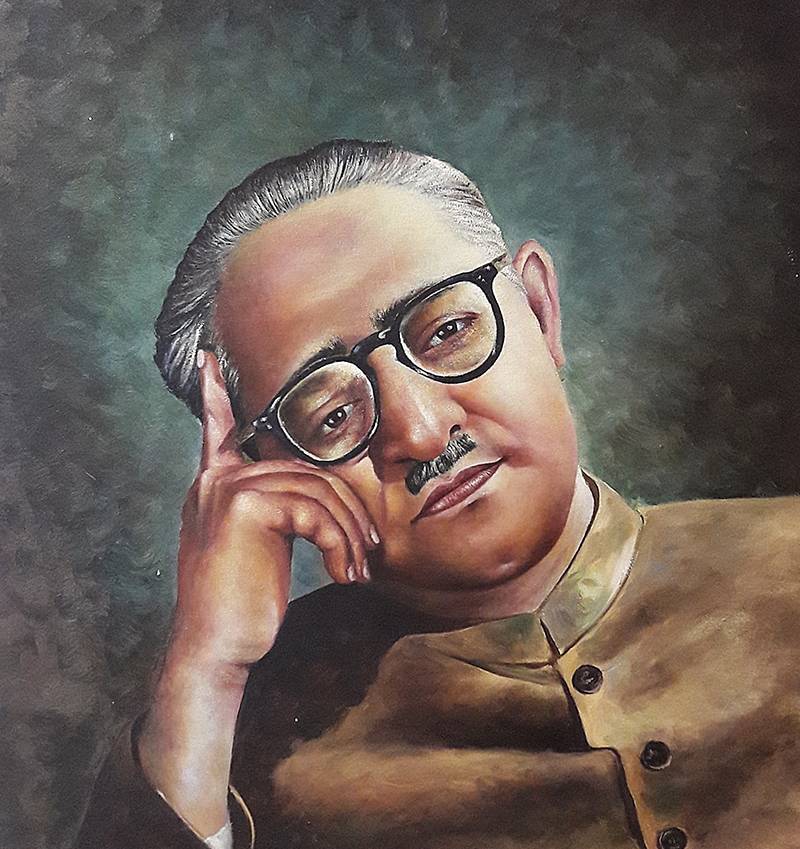
Abdul Husein M. Thariani (1907 – 1972 )
Abdul Husein M. Thariani was born in 1907 in Bombay. He lost his father at the age of three and was brought up by his maternal uncle. He received his professional education from the J. J. School of Architecture, graduating with distinction in 1929. Soon after graduation he started his own practice and designed many buildings all over India. He was also the Consulting Architect to the State of Junagadh.
Mr. Thariani was not just an Architect, but also a Poet, Journalist and a Man of Letters. He was Editor of the daily Gujrati paper ‘Vatan’, which had been established by the Quaid-e-Azam to gain the support of the Gujrati-speaking people for his Independence Movement. Because of his close association with the Muslim League and his active role in politics, Mr. Thariani was forced to migrate to Pakistan in 1947, leaving behind his successful practice.
After migration, he settled in Karachi, where he was associated with the Habib Group as a Consulting Architect and Chief Executive at the Haydari Construction Co., which carried out a number of projects, both Private and Governmental, under his aegis, Later he launched his own firm by the name of Abdul Husein Thariani & Co.
In 1953 he was elected Associate of the Association of Architects, London.
Mr. Thariani’s company designed a large number of prominent buildings in Pakistan, as well as East Pakistan (now Bangladesh) – the most outstanding of these being the Bait-ul Mukarram Mosque in Dhaka, which is now a national emblem of Bangladesh. He was also Consulting Architect to the Princely State of Bahawalpur before its merger into West Pakistan.
Abdul Husein Thariani was an accomplished poet, writing under the pen-name ‘Sabir’. His collection of Gujrati verses so impressed the eminent poet Josh Malihabadi that he undertook an Urdu translation of it in verse-form, which was titled ‘Sabir ke Moti’ (Pearls of Sabir). Doctor Hilal Naqvi has just published this poetical rendering of Josh Saheb of Sabir’s Quatrains.
Mr. Thariani also published a diwan of his Urdu poems, introduced by Hazrat Josh Malihabadi in his inimitable style.
Abdul Husein Thariani passed away in December of 1972, leaving behind three sons and two daughters. His sons Saleem and Azad Thariani have also made important contributions to architecture in Pakistan.
Design Philosophy
Thariani’s architecture was distinctly Modern with a classical touch. The inclination towards purity of form is most evident in his masterpiece, the Bait-ul Mukaram Mosque, but is also observed in other buildings. Geometry and proportion were essential elements of his design.
Works
- Baitul Mukarram Mosque, Dhaka
- State Bank of Pakistan, Dhaka
- National Bank of Pakistan, Dhaka
- Mohammadi House, Karachi
- Valika Textile Mills, Karachi
- Shah-e-Khorasan Mosque, Karachi
- Memon Mosque Minaret, Karachi
- Adamjee House, Karachi
- Adamjee Cotton Mills, Karachi
- Habib Square, Karachi
Influences
Sir Edwin Lutyens
Le Corbusier
Achievements and Legacy
Consulting Architect to the State of Junagadh
Consulting Architect to the State of Bahawalpur
Fellow of the Indian Institute of Architects
Associate of the Association of Architects, London
Twice-serving President of the Federation of Architects and Engineers, Pakistan